Episode 4: Testing & Quality Assurance
Learning Objectives
By the end of this episode, you will:
- Write effective tests with pytest
- Measure code coverage
- Format code with black and ruff
- Check types with mypy
- Set up pre-commit hooks for automation
- Configure tool settings in pyproject.toml
🎬 Ensuring Quality
Sarah's kir-pydemo package is growing, and she's worried:
"I added new features, but did I break anything? How do I know my code works correctly? What if I accidentally introduce bugs?"
A colleague suggests: "You need automated testing and code quality tools!"
The solution? A comprehensive testing and quality assurance setup!
🧪 Testing with pytest
Why Write Tests?
- Catch bugs early before users find them
- Prevent regressions when adding features
- Document behavior through examples
- Enable refactoring with confidence
Installing pytest
We already added it to our [dev] extras:
Step 1: Create Test Files
Create tests/test_sequence.py:
"""Tests for sequence analysis functions."""

import pytest

from kir_pydemo.sequence import gc_content, reverse_complement


class TestGCContent:
    """Tests for GC content calculation."""

    def test_basic_gc_content(self):
        """Test basic GC content calculation."""
        assert gc_content("ATGC") == 50.0
        assert gc_content("AAAA") == 0.0
        assert gc_content("GGGG") == 100.0
        assert gc_content("CCCC") == 100.0

    def test_mixed_case(self):
        """Test that mixed case is handled correctly."""
        assert gc_content("AtGc") == 50.0
        assert gc_content("atgc") == 50.0
        assert gc_content("ATGC") == 50.0

    def test_empty_sequence_raises_error(self):
        """Test that empty sequence raises ValueError."""
        with pytest.raises(ValueError, match="cannot be empty"):
            gc_content("")

    def test_long_sequence(self):
        """Test with a longer sequence."""
        seq = "ATGC" * 1000  # 4000 bp, 50% GC
        assert gc_content(seq) == 50.0

    @pytest.mark.parametrize("sequence,expected", [
        ("ATGC", 50.0),
        ("AAAA", 0.0),
        ("GGGG", 100.0),
        ("ATATATATATAT", 0.0),
        ("GCGCGCGCGCGC", 100.0),
        ("AATTCCGG", 50.0),
    ])
    def test_various_sequences(self, sequence, expected):
        """Test GC content with various sequences."""
        assert gc_content(sequence) == expected


class TestReverseComplement:
    """Tests for reverse complement."""

    def test_basic_reverse_complement(self):
        """Test basic reverse complement."""
        assert reverse_complement("ATGC") == "GCAT"
        assert reverse_complement("AAAA") == "TTTT"
        assert reverse_complement("GGGG") == "CCCC"

    def test_palindrome(self):
        """Test palindromic sequences."""
        # GAATTC is a palindrome
        assert reverse_complement("GAATTC") == "GAATTC"

    def test_mixed_case(self):
        """Test mixed case handling."""
        assert reverse_complement("AtGc") == "gCaT"
        assert reverse_complement("atgc") == "gcat"

    def test_empty_sequence(self):
        """Test empty sequence returns empty."""
        assert reverse_complement("") == ""

    @pytest.mark.parametrize("sequence,expected", [
        ("A", "T"),
        ("T", "A"),
        ("G", "C"),
        ("C", "G"),
        ("AT", "AT"),
        ("ATCG", "CGAT"),
    ])
    def test_individual_bases(self, sequence, expected):
        """Test individual bases and small sequences."""
        assert reverse_complement(sequence) == expected
Test Organization
- Group related tests in classes
- Use descriptive test names:
test_what_condition_expected - Test both normal cases and edge cases
- Use
@pytest.mark.parametrizefor multiple similar tests
Step 2: Run Tests
Step 3: Code Coverage
See which parts of your code are tested:
Output:
Coverage Goals
- 80%+ is good for most projects
- 100% is ideal but not always practical
- Focus on testing critical paths, not just hitting 100%
Step 4: Testing CLI
Create tests/test_cli.py:
"""Tests for command-line interface."""

import sys
from pathlib import Path
from unittest.mock import patch

import pytest

from kir_pydemo.cli import main


def test_gc_content_command(capsys):
    """Test gc-content command."""
    testargs = ["kir-pydemo", "gc-content", "ATGC"]
    with patch.object(sys, 'argv', testargs):
        exit_code = main()

    captured = capsys.readouterr()
    assert exit_code == 0
    assert "50.00%" in captured.out


def test_reverse_complement_command(capsys):
    """Test reverse-complement command."""
    testargs = ["kir-pydemo", "reverse-complement", "ATGC"]
    with patch.object(sys, 'argv', testargs):
        exit_code = main()

    captured = capsys.readouterr()
    assert exit_code == 0
    assert "GCAT" in captured.out


def test_missing_sequence_error(capsys):
    """Test error when no sequence provided."""
    testargs = ["kir-pydemo", "gc-content"]
    with patch.object(sys, 'argv', testargs):
        exit_code = main()

    captured = capsys.readouterr()
    assert exit_code == 1
    assert "Error" in captured.err


def test_version_flag(capsys):
    """Test --version flag."""
    testargs = ["kir-pydemo", "--version"]
    with patch.object(sys, 'argv', testargs):
        with pytest.raises(SystemExit) as exc_info:
            main()

    assert exc_info.value.code == 0
🎨 Code Formatting
Black - The Uncompromising Code Formatter
Black formats Python code automatically:
Before:
def gc_content(sequence:str)->float:
    if not sequence:raise ValueError("Sequence cannot be empty")
    sequence=sequence.upper()
    return (sequence.count('G')+sequence.count('C'))/len(sequence)*100
After:
Ruff - Fast Python Linter
Ruff is an extremely fast linter that checks for errors and style issues:
Configuration in pyproject.toml
Add tool configurations to pyproject.toml:
[tool.black]
line-length = 100
target-version = ["py39", "py310", "py311", "py312"]
include = '\.pyi?$'

[tool.ruff]
line-length = 100
target-version = "py39"

[tool.ruff.lint]
select = [
    "E",   # pycodestyle errors
    "W",   # pycodestyle warnings
    "F",   # pyflakes
    "I",   # isort (import sorting)
    "B",   # flake8-bugbear
    "C4",  # flake8-comprehensions
    "UP",  # pyupgrade
]
ignore = [
    "E501",  # line too long (handled by formatter)
]

[tool.ruff.lint.per-file-ignores]
"__init__.py" = ["F401"]  # Allow unused imports in __init__.py

[tool.pytest.ini_options]
testpaths = ["tests"]
python_files = ["test_*.py"]
python_classes = ["Test*"]
python_functions = ["test_*"]
addopts = [
    "--strict-markers",
    "--strict-config",
    "-ra",
]

[tool.coverage.run]
source = ["kir_pydemo"]
omit = ["*/tests/*"]

[tool.coverage.report]
exclude_lines = [
    "pragma: no cover",
    "def __repr__",
    "raise AssertionError",
    "raise NotImplementedError",
    "if __name__ == .__main__.:",
    "if TYPE_CHECKING:",
]
🔍 Type Checking with mypy
mypy checks type hints for errors:
Example issues mypy catches:
# ❌ Type error
def gc_content(sequence: str) -> float:
    return sequence.count('G')  # Returns int, not float!

# ✅ Fixed
def gc_content(sequence: str) -> float:
    return float(sequence.count('G'))
Configure mypy
Add to pyproject.toml:
🪝 Pre-commit Hooks
Pre-commit runs checks automatically before each commit:
Step 1: Install pre-commit
Step 2: Create .pre-commit-config.yaml
# .pre-commit-config.yaml
repos:
  - repo: https://github.com/pre-commit/pre-commit-hooks
    rev: v4.5.0
    hooks:
      - id: trailing-whitespace
      - id: end-of-file-fixer
      - id: check-yaml
      - id: check-added-large-files
      - id: check-toml

  - repo: https://github.com/psf/black
    rev: 23.12.1
    hooks:
      - id: black

  - repo: https://github.com/astral-sh/ruff-pre-commit
    rev: v0.1.13
    hooks:
      - id: ruff
        args: [--fix]
      - id: ruff-format

  - repo: https://github.com/pre-commit/mirrors-mypy
    rev: v1.8.0
    hooks:
      - id: mypy
Step 3: Install the hooks
Now checks run automatically on git commit:
Output
[WARNING] Unstaged files detected.
[INFO] Stashing unstaged files to /home/dinindu/.cache/pre-commit/patch1776361930-81948.
trim trailing whitespace.................................................Passed
fix end of files.........................................................Failed
- hook id: end-of-file-fixer
- exit code: 1
- files were modified by this hook

Fixing src/kir_pydemo.egg-info/dependency_links.txt
Fixing src/kir_pydemo.egg-info/SOURCES.txt

check yaml...............................................................Passed
check for added large files..............................................Passed
check toml...............................................................Passed
black....................................................................Failed
- hook id: black
- files were modified by this hook

reformatted src/kir_pydemo/io.py

All done! ✨ 🍰 ✨
1 file reformatted, 5 files left unchanged.

ruff.....................................................................Failed
- hook id: ruff
- files were modified by this hook

Found 7 errors (7 fixed, 0 remaining).

ruff-format..............................................................Passed
mypy.....................................................................Passed
[WARNING] Stashed changes conflicted with hook auto-fixes... Rolling back fixes...
[INFO] Restored changes from /home/dinindu/.cache/pre-commit/patch1776361930-81948.
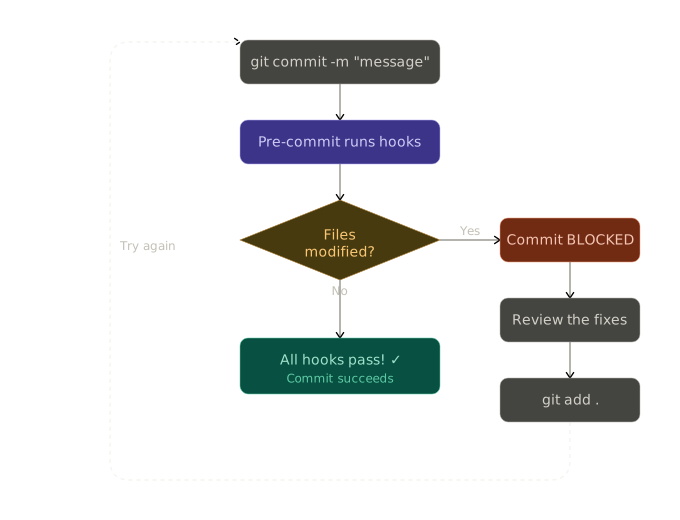
What Pre-commit Did Pre-commit automatically fixed issues before allowing your commit:
- ✅ end-of-file-fixer - Added missing newlines at end of files
- ✅ black - Reformatted io.py to meet style standards
- ✅ ruff - Fixed 7 auto-fixable linting issues
Why It "Failed" The hooks show as "Failed" because they modified your files. Pre-commit blocks the commit to let you review the automatic changes. This is a safety feature - it prevents you from committing code that doesn't meet your quality standards.
What To Do Next Now you need to stage the auto-fixed changes and commit again:
# Stage the automatically fixed files
git add -u

# Or stage everything
git add .

# Try committing again
git commit -m "Add new feature"
This time, it should pass! ✅
Pro Tip
You can see what changed:
Pre-commit Workflow
Skip Hooks When Needed
📋 Development Workflow
A typical development session:
# 1. Activate virtual environment
source venv/bin/activate

# 2. Install in editable mode with dev dependencies
pip install -e ".[dev]"

# 3. Install pre-commit hooks
pre-commit install

# 4. Make changes to code
# ... edit src/kir_pydemo/sequence.py

# 5. Run tests
pytest

# 6. Check coverage
pytest --cov=kir_pydemo --cov-report=term-missing

# 7. Format code
black src/ tests/
ruff check --fix src/ tests/

# 8. Type check
mypy src/

# 9. Commit (pre-commit runs automatically)
git add .
git commit -m "Add feature X"
Above might fail
tests/test_sequence.py:10: error: Function is missing a return type annotation  [no-untyped-def]
tests/test_sequence.py:10: note: Use "-> None" if function does not return a value
tests/test_sequence.py:17: error: Function is missing a return type annotation  [no-untyped-def]
tests/test_sequence.py:17: note: Use "-> None" if function does not return a value
tests/test_sequence.py:23: error: Function is missing a return type annotation  [no-untyped-def]
tests/test_sequence.py:23: note: Use "-> None" if function does not return a value
tests/test_sequence.py:28: error: Function is missing a return type annotation  [no-untyped-def]
tests/test_sequence.py:28: note: Use "-> None" if function does not return a value
tests/test_sequence.py:44: error: Function is missing a type annotation  [no-untyped-def]
tests/test_sequence.py:52: error: Function is missing a return type annotation  [no-untyped-def]
tests/test_sequence.py:52: note: Use "-> None" if function does not return a value
tests/test_sequence.py:58: error: Function is missing a return type annotation  [no-untyped-def]
tests/test_sequence.py:58: note: Use "-> None" if function does not return a value
tests/test_sequence.py:63: error: Function is missing a return type annotation  [no-untyped-def]
tests/test_sequence.py:63: note: Use "-> None" if function does not return a value
tests/test_sequence.py:68: error: Function is missing a return type annotation  [no-untyped-def]
tests/test_sequence.py:68: note: Use "-> None" if function does not return a value
tests/test_sequence.py:83: error: Function is missing a type annotation  [no-untyped-def]
tests/test_cli.py:10: error: Function is missing a type annotation  [no-untyped-def]
tests/test_cli.py:21: error: Function is missing a type annotation  [no-untyped-def]
tests/test_cli.py:32: error: Function is missing a type annotation  [no-untyped-def]
tests/test_cli.py:43: error: Function is missing a type annotation  [no-untyped-def]
Found 14 errors in 2 files (checked 2 source files)
- Why ? mypy is now checking your test files and complaining that test functions don't have type annotations.
- The Issue
mypyconfig has disallow_untyped_defs = true, which means every function must have type hints. Test functions like:- Need to be:
- The Fix ( Easiest) - Relax mypy Rules for Tests
- Add this to your mypy config in
pyproject.toml
- Add this to your mypy config in
Makefile for Common Tasks
Create a Makefile:
.PHONY: install test coverage format lint type-check clean all

install:
    pip install -e ".[dev]"
    pre-commit install

test:
    pytest

coverage:
    pytest --cov=kir_pydemo --cov-report=html --cov-report=term

format:
    black src/ tests/
    ruff check --fix src/ tests/

lint:
    ruff check src/ tests/

type-check:
    mypy src/

clean:
    rm -rf build dist *.egg-info
    rm -rf htmlcov .coverage
    rm -rf .pytest_cache .mypy_cache .ruff_cache
    find . -type d -name __pycache__ -exec rm -rf {} +

all: format lint type-check test
Usage:
make install      # Install package and hooks
make test         # Run tests
make coverage     # Test with coverage report
make format       # Format code
make lint         # Check linting
make type-check   # Check types
make all          # Run all checks
make clean        # Clean build artifacts
📋 Checkpoint: What Have We Achieved?
Verify you've successfully completed Episode 4:
- Written tests in
tests/test_sequence.py - Run tests with pytest and achieved >80% coverage
- Configured black, ruff, and mypy in
pyproject.toml - Formatted code with black or ruff format
- Fixed linting issues with ruff
- Type-checked code with mypy
- Set up pre-commit hooks with
.pre-commit-config.yaml - Created a
Makefilefor common development tasks
🎯 Key Takeaways
- pytest provides powerful testing with fixtures, parametrize, and coverage
- black/ruff automatically format code to a consistent style
- mypy catches type errors before runtime
- pre-commit automates checks before each commit
- pyproject.toml centralizes tool configuration
- Makefile simplifies common development commands
🚀 What's Next?
In Episode 5 (the finale!), we'll learn how to Build & Distribute kir-pydemo:
- Building wheel and source distributions
- Version management strategies
- Publishing to PyPI (or private repos)
- Creating documentation with Sphinx
- CI/CD with GitHub Actions
This will make your package ready for the world!
📚 Further Reading
- pytest documentation
- Black documentation
- Ruff documentation
- mypy documentation
- pre-commit documentation